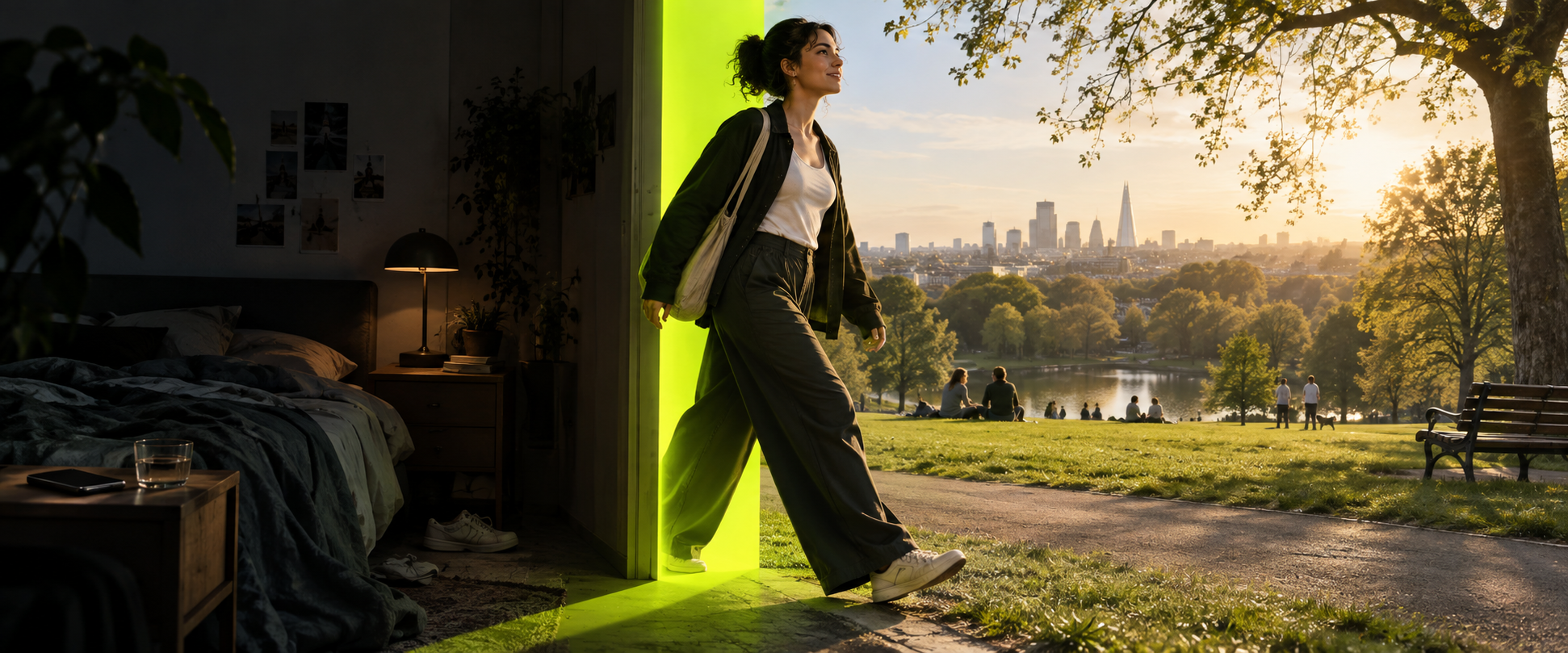
The morning you didn’t choose.
Nobody sat down and decided to check their phone before getting out of bed. It was decided for us, by people who were paid to decide it.
Think about the last time you woke up. Not an unusual morning — an ordinary Tuesday. What was the first thing you did?
For most people the honest answer is that they reached sideways, found a rectangle, and started reading. Not because they had something to read. Because the rectangle was there and the habit was already running.
Here is the part worth sitting with: you did not decide that. There was no morning where you weighed it up and concluded that the best possible start to a day was other people’s opinions, delivered at volume, before your feet touched the floor.
The habit was designed. It just was not designed by you.
Somebody was paid to make the notification arrive at the right moment. Somebody A/B tested the red of the badge. Somebody discovered that an infinite feed outperforms a finite one, and shipped it. None of these people were malicious. They had targets, and they hit them.
The result is a morning routine that nobody chose and almost everybody has.
The interesting question is not how to stop
Most attempts at this go straight for abstinence. Delete the apps. Buy a dumbphone. Do a digital detox, which is a phrase that manages to sound both medical and slightly embarrassing.
These work, briefly, in the way crash diets work briefly. The problem is not that they are too hard. The problem is that they are answering the wrong question. Abstinence asks how to have less of something. It does not ask what should come first.
NOT YET does not block anything permanently. It puts one thing in front of the apps you chose — a walk, going outside, ten push-ups, arriving somewhere, one task you named the night before. When you have done it, everything opens. That is the entire product.
Order turns out to matter more than quantity. Nobody in our testing wanted to use their phone less in the abstract. What they wanted was to not lose the first hour of the day to it — which is a different problem with a much simpler solution.
Why the night before does the work
You are a different person at 10pm than at 6.52am. The 10pm version has opinions about how tomorrow should go. The 6.52am version has none, and will do whatever is easiest.
Every good system in this space exploits that gap. You set the rule when you are thoughtful; it applies when you are not. That is not a trick, and it is not willpower either — it is just putting the decision in the hands of the version of you who is awake enough to make it.
Friction beats discipline, because friction does not get tired.
It also has to be escapable. A rule you cannot get out of is a cage, and people rightly do not install cages on the thing they use to call an ambulance. So the override always works, immediately, with no questions and no record of why. Almost nobody uses it. The fact that they could is what makes the rest tolerable.
One thing, then the phone
Walk a thousand steps. Stand outside for two minutes. Do the one task you wrote down last night. None of it is impressive, and that is deliberate — the point is not the achievement, it is that something real happened before the feed did.
Do it for a month and the ordering starts to feel normal. Do it for three and the old sequence feels slightly deranged, which is the correct response to it.
You will not get the hour back as a lump sum. You get it in the shape of a morning that starts with you in it.
Pick the apps. Pick the rule. Wake up to a phone that waits until you have done the thing you said you would do.