Skip to contentFor NHS, public health & charities
A practical tool
for everyday routines.
NOT YET asks for a small real-world action — a walk outside, some movement, a completed focus session — before distracting apps become available.
Signposting now
Partnerships Q2 2027

A walk that counts, on a path someone was going to take anyway.
The whole product
One screen, one behaviour.
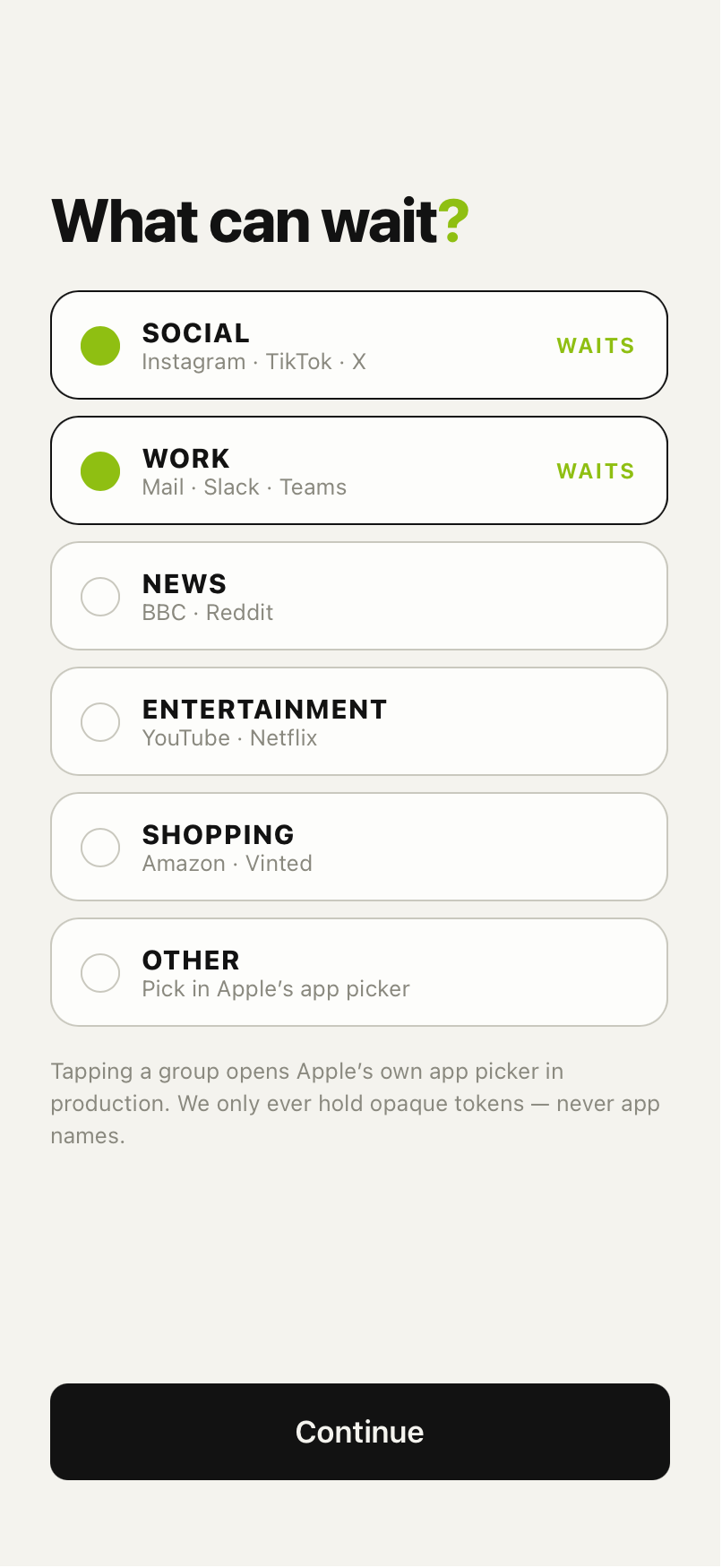
This is the app: chosen apps shut, one condition to open them, and an override that always works. No content library, no clinical claim, nothing to onboard.
What this is, and is not
WHAT IT IS
An independent, iPhone-first consumer app. Two propositions are relevant to health-sector organisations: signposting the public to it as one of several self-help digital wellbeing resources, or sponsored access for staff as part of a workforce offer.
WHAT IT IS NOT
Not a medical device. Not a treatment, therapy or clinical intervention. It does not diagnose, treat or prevent anything, and we make no clinical, causal or outcome claim without measured evidence.
Signposting costs your organisation nothing and requires no integration, no procurement and no data sharing.
Why it clears procurement
There is almost nothing to assess
Data
Local-first by design
App selections never leave the device. Location is sampled at a claim, never tracked. Health data is permissioned, minimised and processed on device.
No accounts
Nothing to breach
No account is required to use the app. There is no continuous location history, so none can be requested, subpoenaed or leaked.
No advertising
No data sales, ever
No advertising profiles, no third-party behavioural sharing, no individual reporting to any buyer.
Safety
Never a lockout
Emergency calling, Messages, Maps and Find My are never restricted. Emergency Override always works, and a window ending always releases.
For the people who work there
A shift does not start at handover.
The NHS is the largest employer in Europe and a great many of those people work shifts. The hour before a long day is the one thing they still control — and it is the hour most easily lost to a phone before the feet even touch the floor.
Night and early shifts
An alarm that needs proof
A 5.30am start is the hardest alarm to honour. The Wake Alarm will not stop until you are up and moving — steps after it rings, a tap on a tag by the door, or push-ups or squats counted by the camera.
Coming off a run of nights
A rule you set the night before
Nobody makes good decisions at the end of four nights. The rule is set when you are capable of setting it, and applies when you are not.
Days off
A Focus Lock for the afternoon
A phone put away for an afternoon with family, without turning the router off or being unreachable. Calls and messages never stop working.
No login, no dashboard
Nothing for the trust to administer
Staff download it and use it. There is no platform to roll out, no account to provision, and nothing running on NHS devices or the network.
For patients and social prescribing
Something a link worker can actually suggest.
We are not a treatment and we will not be described as one. What we are is a small, cheap, self-directed tool for a person who has decided they want to be outside more, or on their phone less — which is a conversation happening in social prescribing every day.
Green social prescribing
A nudge toward the walk, not a prescription
A link worker suggesting a daily walk has no way to make the phone wait until it happens. This is that, and nothing more clinical than that.
Self-directed
The patient sets it, not the service
Nobody in the NHS configures anything, sees anything or is responsible for anything. The person chooses the apps, the rule and the window.
Always escapable
The override always works
Emergency calls, messages, maps and 999 are never restricted, and the override works offline with no explanation required. That is non-negotiable in any care setting.
Waiting rooms and practices
Materials, free
If a practice wants a poster or a card for a noticeboard, we print and post it free. No listing fee, no commission, nothing to procure.
The part that matters most here
What we will not claim to the NHS.
This is the section we would want read first. Every plausible-sounding health claim about this product is one we have no evidence for — and making it to a health service would be both wrong and the fastest way to lose the conversation.
What we can evidence
Rules people set, and whether they completed them
Minutes selected apps stayed unavailable
Steps contributed by adults who opted in
Retention at 30 and 90 days
Every figure with its methodology and limits attached
What we will never say
That it treats, manages or improves any condition
That it improves mental health, anxiety or mood
That it helps with ADHD or any diagnosis
That it reduces burnout or staff turnover
That it is a medical device, or acts like one
Anything a clinician could mistake for a clinical claim
Classified non-clinical, and kept that way deliberately. We make no clinical claim, so DCB0129 and DCB0160 do not apply and we do not appoint a Clinical Safety Officer. If we ever made a claim that changed that, it would be the claim that was wrong — not the classification.
What your reviewers will ask for
The pack, and what is honestly not ready.
We would rather show you the dates than imply everything exists. NHS conversations start in Q2 2027, and these are the artefacts that will be in hand by then.
DPIA and ROPA extract
AVAILABLE
Data protection impact assessment and the record of processing.
Cyber Essentials Plus
DECEMBER
Independently assessed. The baseline DSPT expects.
Penetration test summary
JANUARY
Independent, with the remediation record.
Accessibility audit · WCAG 2.2 AA
JANUARY
App, site, portals and reports. Findings published.
DSPT self-assessment
Q1 2027
Completed once CE+ and the pen test supply the evidence.
DTAC response
Q2 2027
Clinical safety, data protection, technical security, interoperability, usability.
Clinical safety classification
NON-CLINICAL
No clinical claim made, so DCB0129 and DCB0160 do not apply.
DSPT and DTAC do not require ISO 27001, and we are not pretending to hold it. They accept Cyber Essentials Plus plus evidence of the underlying controls, which is the route we are taking — December for CE+, January for the penetration test and the accessibility audit.